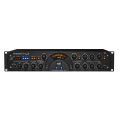
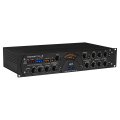
SPL Channel One Mk3 Recording Channel Studio Signal Processing
Manufacturer: SPL
For over two decades, Channel One has epitomized top-notch, sonorous recording and mixing channel strips. The updated Mk3 version elevates this legacy with enhanced audio internals, improved preamps, integrated Transient Designer, Tube Saturation, and Mic A/B options, enriching any modern studio setup. It retains essential channel strip features like de-esser, compressor, and equalizer, ensuring any input is professionally refined. The SPL Studio Series' new design accentuates the advanced acoustic capabilities of the 3rd generation Channel One.
Usually Ships in 1-3 Working Days
£1,779.00
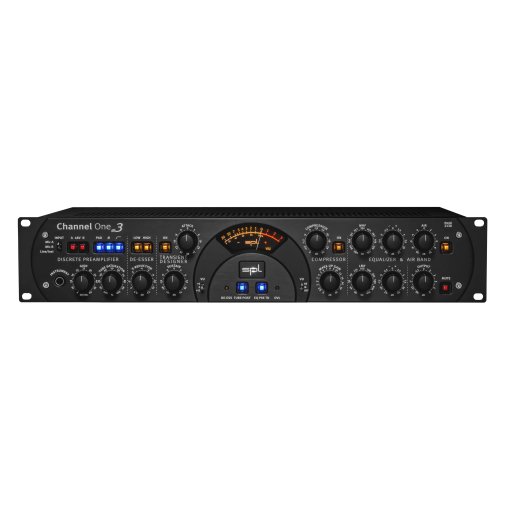
The SPL Channel One MK3 Channel Strip comes with a spec list that reads like an SPL best-off album. Valve driven, this unit already features a truly unique preamp section that, on its own is neutral and clean but, when you hit the Tube Saturation button, is able to apply some warm and saturated, tube-style magic. This channel strip also provides two microphone inputs so that, via the Mic A/B switch on the front panel, you can quickly switch between the two inputs and compare the results of different models or angles.
SPL Channel One MK3 Processors
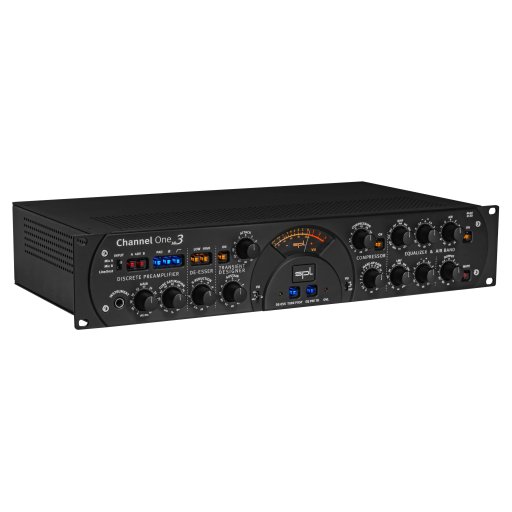
Beyond the basics, the Channel One MK3 houses an imposing collection of innovative sound-shaping tools. The De-Esser helps soften the sharper edges, does its job with excellent transparency and gives users the pick of two frequency ranges. The Transient Designer can be used for processing the dynamics in an entirely different way to compression, where the attack and/or decay of an instrument or vocal can be strengthened or weakened no matter how loud the source is. At the end of the chain, you get a compressor and EQ section, each boasting the level of performance you'd only expect from SPL kit and each kitted out with intuitive controls.
Control elements
The Channel One Mk3 has the option of reducing the intensity of S-sounds by changing the position of the S-Reduction control. De-essers from SPL work with filters that only process the frequencies of the sibilants, but not the rest of the spectrum, which means that the character of the voice remains unchanged. As soon as an S-sound is detected, a small yellow LED lights up in the bottom center of the device. The "Low & High" buttons of the S-reduction section can each be used to activate a different mid-frequency for the de-esser. If the "Low" switch is pressed, the low de-essing band is activated with a center frequency of 6.4 kHz and a bandwidth of 4.4 kHz. If the "High" switch is pressed, the high de-essing band is activated with a center frequency of 11.2 kHz and a bandwidth of 4.9 kHz. If both switches are pressed, the low- and high-band de-esser are active.
The compressor section on the right-hand side of the device consists of two controls and a switch. The Compression control is used to set a threshold value between 0dB and -20dB. The make-up gain control, on the other hand, raises the level, which has been reduced by the overall level reduction caused by compression, to the set level. A value from 0dB to 20dB can be set. The entire compressor section must first be switched on using the "On" switch. The attack and release times of the compressor are set automatically by the device and thus adapt perfectly to the input signal.
The EQ and Air Band section of the Channel One Mk3 consists of a total of 5 controls. Two of these are responsible for the semi-parametric bass/midrange filter (LMF). The adjustable frequency range of the filter is between 30Hz and 700Hz and the gain/attenuation is determined via the "-/+" control. In addition to the LMF, the device also has a semi-parametric mid/high frequency filter(MHF) with an adjustable frequency range of 680Hz to 15kHz. The gain or attenuation can also be varied using the "-/+" control. The maximum gain and attenuation values for LMF and HMF are +/- 12dB. Finally, this section contains the knob for the air filter. This is used to process the upper frequency range and consists of a coil-capacitor filter with a bell characteristic. Its center frequency is 19kHz, with a possible attenuation/boost of -/+10dB. To activate the equalizer section, the "On" switch must be flipped.
The output level of the device is controlled using the output control in the bottom right-hand corner. The control can attenuate the signal by up to -20dB or boost it by up to +6dB. This function ensures that subsequent devices are optimally controlled. The set output level is visually displayed on the large VU meter in the middle of the Channel One Mk3 when the VU switch is in the "Out" position. If an overload is detected in the device, the red "OVL" LED lights up. The display picks up on all relevant points of the signal flow.
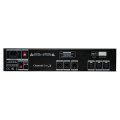
Connections
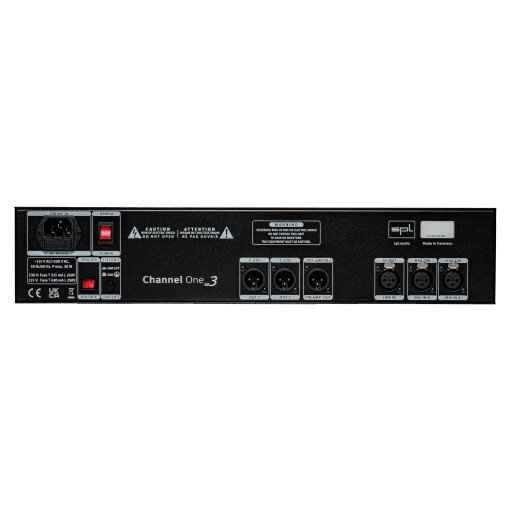
- Out 1 & 2: balanced three-pin XLR output sockets for the output signal (connected in parallel)
- Preamp Out: balanced three-pin XLR output socket. The pure pre-amplified microphone signal is available here, even without any processing by the Channel One Mk3
- Line In: balanced three-pin XLR input socket for low-impedance line signals (less than 1 kΩ)
- Mic A & Mic B: balanced three-pin XLR input socket for connecting all types of microphones. Two microphones can be connected simultaneously
- Instrument: The instrument input is located on the front of the device. The 6.35mm jack socket is designed for the connection of high-powered (higher than 1kΩ) instruments
- Mains connection