LTO Storage

LTO Tape Storage
Reliable, air-gapped archiving for media, broadcast, and data-intensive workflows
What is LTO?
LTO — Linear Tape-Open — is the world’s most widely adopted tape format, and has been the go-to backup and archive medium for media, healthcare, finance, and any organisation with stringent data integrity or regulatory requirements.
Since its introduction in 2000, LTO has gone through ten generations, with each iteration delivering more capacity, faster transfer speeds, and improved data integrity. As of 2026, the latest generation is LTO-10. The format is jointly maintained by Hewlett Packard Enterprise, IBM, and Quantum under the LTO Consortium — an open standard with no vendor lock-in.
LTO tape is sold and supported by Mediaspec in desktop, rackmount, and tape library configurations from two primary manufacturers: Symply and Quantum.
Why Use LTO Tape?
✓ True air-gapped protection
Once a cartridge is ejected from the drive it is completely offline and physically disconnected from any network. Ransomware, malware, and cyberattacks cannot reach it. For organisations that need to be certain their archive is safe regardless of what happens on the network, LTO provides a level of security that neither cloud storage nor disk arrays can match.
✓ Lowest cost per terabyte
The cost of LTO media per terabyte is significantly lower than disk or cloud storage for long-term retention. A single LTO-10 cartridge holds up to 40 TB native (100 TB compressed), and cartridges themselves are inexpensive compared to hard drives or cloud storage fees at scale. For organisations with large archives that rarely need to be accessed, the total cost of ownership case for LTO is compelling.
✓ Long archival life
LTO cartridges are rated for a 30-year archival life under correct storage conditions. Hard drives have a significantly shorter reliable lifespan, and the long-term economics of cloud storage depend on subscription pricing that may change. For true long-term archiving — project masters, compliance records, broadcast content — LTO remains the most dependable choice.
✓ Portable and transportable
LTO cartridges are compact and can be physically transported offsite for disaster recovery, exchanged between facilities for collaboration, or stored in a secure off-premises location. Unlike cloud or networked storage, the archive travels with you without any dependence on network connectivity or bandwidth.
✓ WORM support for compliance
Write-Once, Read-Many (WORM) cartridges ensure that once data is written it cannot be altered or deleted. This is a requirement in many regulated industries including healthcare, finance, and broadcasting, where audit trails and data immutability are mandatory. LTO’s hardware-based WORM support makes compliance straightforward.
✓ Simple drag-and-drop with LTFS
The Linear Tape File System (LTFS) standard allows LTO cartridges to mount on a desktop like an ordinary external drive, making files immediately browsable and transferable without specialist backup software. LTFS also ensures interoperability across Windows, macOS, and Linux, and between drives from different manufacturers.
✓ Hardware encryption built in
All current LTO drives include AES 256-bit hardware-based encryption as standard. Cartridges containing sensitive data can be encrypted at the drive level — with no performance penalty — ensuring that even if a tape is lost or stolen in transit, the data remains unreadable without the correct key.
✓ Energy efficient at scale
Tape consumes power only when actively reading or writing. Unlike disk arrays that spin continuously, a shelf of LTO cartridges draws no power at all when idle. Shifting cold storage from disk to tape can reduce energy consumption by around 90% per petabyte compared to always-on hard drive arrays — a meaningful consideration for facilities looking to reduce both cost and environmental impact.
LTO and Shared Storage — Better Together
LTO and a shared storage server like a DDP serve different but complementary roles in a storage workflow. A DDP (or similar shared storage system) provides fast, high-bandwidth shared access for active projects — the footage your editors are working with today. LTO sits at the end of that workflow as the final archive tier: once a project is complete, or media has been ingest-offloaded from camera originals, it moves to tape for long-term retention.
This combination is known as a tiered storage strategy, and it is the approach used by the majority of professional post-production, broadcast, and content facilities. Active media lives on fast shared storage. Completed or seldom-accessed media moves to tape, freeing up expensive online capacity.
Mediaspec sells both DDP shared storage systems and LTO tape solutions, and can advise on integrating the two into a cohesive archive workflow. Contact our team to discuss your requirements.
LTO Generations — Which Should You Buy?
Each generation of LTO increases native capacity and transfer speed. The key compatibility rule: drives can read and write to the same generation, and read and write to one generation prior. LTO-10 is the first generation to drop all backward compatibility — it only reads and writes LTO-10 media.
| Generation | Released | Native capacity | Compressed capacity | Native transfer rate | Reads/writes | Notes |
|---|---|---|---|---|---|---|
| LTO-7 | 2015 | 6 TB | 15 TB | 300 MB/s | LTO-7, LTO-6 (R/W), LTO-5 (read only) | Still in use; available as a lower-cost entry point. LTO-9 drives cannot read LTO-7. |
| LTO-8 | 2017 | 12 TB | 30 TB | 360 MB/s | LTO-8, LTO-7 (R/W) | Widely deployed. Compatible with LTO-7 Type M (M8) format for extended capacity on unused LTO-7 media. |
| LTO-9 | 2021 | 18 TB | 45 TB | 400 MB/s (FH) / 300 MB/s (HH) | LTO-9, LTO-8 (R/W) | Current mainstream generation. New LTO-9 media required initialisation before first use — an up-to-2-hour process per tape that LTO-10 eliminates. |
| LTO-10 | 2025 | 30 TB (or 40 TB with new Aramid media) | 75 TB (or 100 TB) | 400 MB/s | LTO-10 only | Latest generation. No backward compatibility with any prior media. Tapes usable straight out of the box — no initialisation required. Full-height drives only at launch; half-height expected 2026. |
Which Generation Is Right for You?
Choose LTO-9 if…
You want the current mainstream generation with the widest ecosystem support, half-height drive availability (useful for desktop or portable setups), and backward compatibility with LTO-8 archives. LTO-9 is available in a wider range of form factors and connectivity options today, including Thunderbolt, Ethernet, and SAS configurations.
Choose LTO-10 if…
You are archiving large projects and want maximum capacity per cartridge — up to 40 TB native on a single tape. LTO-10 eliminates the tape initialisation process required for LTO-9, saving significant time at scale. If you are starting a fresh archive with no legacy tapes, LTO-10 is the better long-term investment.
Migrating an existing archive?
If you have LTO-7 or older tapes, now is the time to plan migration before those drives become harder to source. LTO-8 and LTO-9 drives can still be purchased new, but generation cycles are finite. Our team can advise on a practical migration path that protects your existing archive while moving you to a current platform.
LTO Products Available from Mediaspec
We supply LTO drives and libraries from Symply and Quantum. Both brands cover the full range of LTO generations and form factors — from compact desktop units designed for studio and field use, through to rackmount drives and automated tape libraries for larger facilities.
Symply — SymplyPRO LTO
Desktop • Rackmount • Tape Libraries
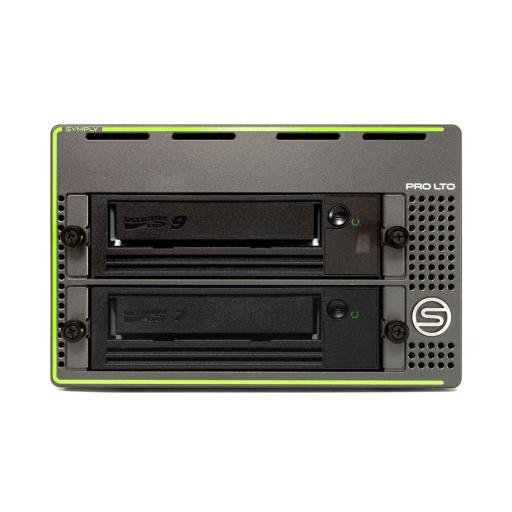
Symply designs its LTO products specifically for media and entertainment workflows, with a strong focus on connectivity options that matter to creative professionals. SymplyPRO LTO tape drives are available with Thunderbolt, Ethernet, and SAS connectivity, supporting LTO-7, LTO-8, LTO-9, and LTO-10 configurations in both half-height and full-height form factors.
The SymplyPRO range spans three main formats:
- SymplyPRO Thunderbolt — desktop units with Thunderbolt 3 and SAS connectivity, designed for studio and on-set use. Compact, whisper-quiet, metal alloy enclosure. Dual Thunderbolt ports for daisy-chaining and device charging. Available in half-height (LTO-7 to LTO-9) and full-height (LTO-9, LTO-10) configurations.
- SymplyPRO Ethernet — desktop and rackmount units with 10GbE connectivity, allowing the drive to be shared over a network without being directly attached to a host computer.
- SymplyPRO XTL 40 & 80 — mid-range and enterprise modular tape libraries supporting SAS, Fibre Channel, Ethernet, and Thunderbolt interfaces. Available in 40 and 80 slot configurations.
Compatible with Archiware, Hedge, YoYotta, Imagine Products, Retrospect, StorageDNA, Veeam, and more.
Quantum — LTO Tape Drives & Libraries
Tabletop • Rackmount • SuperLoader • Scalar Libraries
Quantum is one of the three LTO Consortium members and has been a leading tape drive manufacturer since the format’s inception. Their LTO product range is well suited to IT-centric environments and larger-scale deployments, with a strong library and automation offering.
The Quantum LTO range spans:
- Half-height tabletop drives — standalone SAS drives in LTO-7, LTO-8, and LTO-9. Simple, affordable, and bundled with DATASTOR Shield backup software with deduplication. Available as tabletop units or in a 1U rackmount kit.
- Full-height drives — LTO-9 and LTO-10 full-height drives delivering up to 1,000 MB/s compressed transfer rate (400 MB/s native), with 32Gb Fibre Channel or 12Gb SAS interfaces.
- SuperLoader 3 — a 2U automated tape autoloader with 8 or 16 tape slots, available with LTO-8 or LTO-9 drives. Ideal for facilities that need automated tape management without a full library.
- Scalar libraries — Quantum’s enterprise tape library range, scaling to very high slot counts for large broadcast, archive, or data centre deployments.
All Quantum drives include DATASTOR Shield backup and deduplication software.
Symply vs Quantum — At a Glance
| Symply SymplyPRO | Quantum | |
|---|---|---|
| Best for | Media & entertainment, on-set, creative studios | IT environments, broadcast, enterprise scale |
| Connectivity | Thunderbolt 3, 10GbE Ethernet, SAS, Fibre Channel | SAS (half-height), SAS & Fibre Channel (full-height) |
| LTO generations | LTO-7 to LTO-10 | LTO-7 to LTO-10 |
| Form factors | Desktop, rackmount, tape library | Tabletop, rackmount, SuperLoader, Scalar library |
| Desktop suitability | Designed for desktop use — quiet, compact, metal alloy chassis | Tabletop models available; primarily IT-focused design |
| Bundled software | SymplyATOM; tested with Archiware, Hedge, YoYotta | DATASTOR Shield backup with deduplication |
| Library options | XTL 40 / XTL 80 modular libraries | SuperLoader 3, Scalar i3, Scalar i6 and above |
Frequently Asked Questions
Not Sure Where to Start?
Choosing the right LTO configuration — generation, form factor, connectivity, and whether to add a library or autoloader — depends on your archive volumes, workflow, and how the tape solution needs to fit alongside your existing storage infrastructure.
Our team has experience specifying LTO solutions across post-production, broadcast, music production, and education environments. We are happy to talk through your requirements and recommend the right system.
- 📞 Call us: 01355 272500
- ✉ Email: info@mediaspec.co.uk
- 💬 Online: Use our contact form and we will get back to you promptly.